Overview
KITH is a 0→1 product design project exploring how to remove friction from the mentor-mentee relationship — from discovery through ongoing accountability. Most professionals know they need a mentor — but don't know how to find one, approach one, or sustain the relationship once it starts. KITH reimagines career guidance as an intentional, structured relationship. Designed end-to-end over 10 weeks: research, IA, wireframes, design system, and hi-fi iOS UI.
The Challenge
Existing platforms are either gated by expensive programs, built for job hunting, or too passive to create real accountability.
Research across 8 interviews with early-career professionals and experienced mentors uncovered three core pain points: the cold approach is the biggest barrier (users know who they'd like to learn from but feel they have no credible reason to reach out), scheduling friction kills momentum (most informal mentorships fade because there's no shared infrastructure), and trust signals determine who you approach (users rely heavily on social proof before making contact). 76% of professionals say mentorship is important to their career — yet only 37% have ever had a formal mentorship relationship.
Key Insights
The cold approach is the biggest barrier
Users know who they'd like to learn from — but feel they have no credible reason to reach out without a warm introduction. The perceived social cost of "cold messaging" a senior person stopped the relationship before it started.
“I've had people I wanted to talk to for years. I just never found the right way to ask.”
Scheduling friction kills momentum
Most informal mentorships fade because there's no shared infrastructure — it all lives in email threads and "let's sync soon" messages. Without a structured cadence, good intentions evaporate.
“We had two great calls and then... life happened. We never got back on track.”
Trust signals determine who you approach
Users rely heavily on social proof — mutual connections, verified credentials, and past mentee reviews — before making contact. The mentor profile needed to surface this before the first message.
“I wouldn't reach out to someone I hadn't vetted pretty deeply first. Too much at stake.”
User Personas
Two sides of the same conversation.
- ·Land her first senior-level role within 18 months
- ·Build a portfolio that stands out without industry connections
- ·Get honest feedback on her career trajectory
- ·Doesn't know who to trust for advice online
- ·Feels isolated in her growth without a senior peer
- ·Paid coaching feels too formal and expensive
“I have so many questions but nowhere to ask them where someone actually knows my context.”
- ·Understand what product management looks like day-to-day
- ·Build credibility in a new domain without starting from scratch
- ·Find a mentor who has made a similar transition
- ·Generic career advice doesn't address his specific pivot
- ·Hard to find mentors with relevant transition experience
- ·Needs accountability, not just information
“I can find articles about career switching all day. What I need is someone who's actually done it.”
Screens & Visuals

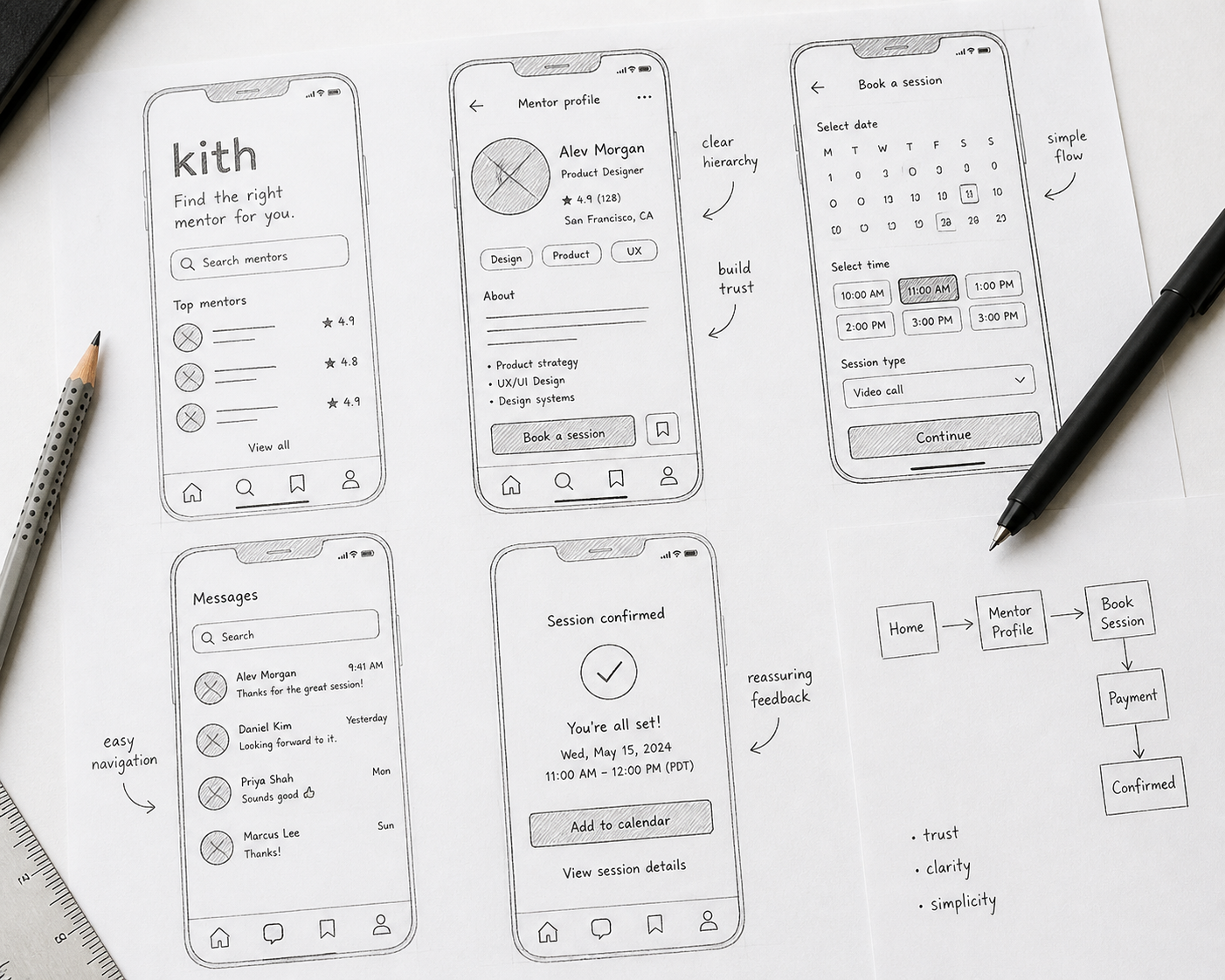
Approach
KITH was designed around three core relationship layers — activation (structured agreement between mentor and mentee), a repeatable check-in loop (weekly progress touchpoints that keep both parties accountable), and outcome tracking (visible milestones that make progress tangible). The discovery experience uses curated matching over raw search — mentees answer structured prompts about their goals, and the algorithm surfaces mentors whose experience maps to those specific needs. Trust signals (verified credentials, past mentee reviews, mutual connections) are surfaced before the first message, lowering the barrier to outreach.
Outcomes
“The KITH project showed Selinay at her best — deep user research, tight information architecture, and a visual language that felt premium without being cold. The trust signals she designed into the mentor profile drove our highest session booking rate in testing.”